Which material would you choose for your main closet?
Angi prices wire organizers at $800–$2,000 and laminate at $1,200–$3,500 installed.
No votes yet. Yours will be the first. · saved on this device
Loading...

Closet Flow Guide · Wire (ventilated) shelving vs Laminate (melamine) panels
Choose coated wire where contents are light, humidity is high or budgets are tight, such as linen, children's and laundry closets; Angi prices it at $800 to $2,000 installed. Choose laminate where drawers, flat shelves and a finished look matter, typically the primary closet and pantry, at $1,200 to $3,500. Many good closets mix the two on different walls.
Wire and laminate represent two approaches to the same wall. Wire is a light, open, adjustable frame. Laminate is a set of solid boxes and shelves. The choice affects what the closet holds, how clothes are treated, how the room handles moisture and how the closet looks when the door is open. It also affects price, but less than people expect once accessories are added.
This page covers where each material belongs, what each costs over time, how climate changes the choice, what goes wrong and how to compare bids. The materials guide places both alongside wood, MDF and garage materials. It assumes you already know roughly how many feet of wall the closet has.
Wire is cheap, adjustable, and breathable but sags, marks soft clothes, and cannot take drawers gracefully. Laminate costs more, takes drawers and doors, and looks finished, but needs a dry closet and careful anchoring.
| Factor | Wire (ventilated) shelving | Laminate (melamine) panels |
|---|---|---|
| Installed cost | $800–$2,000 (Angi); materials from $150 (HomeGuide) | $1,200–$3,500 (Angi); wood-grain finish up to +40% (HomeGuide) |
| Load capacity | Moderate; sags under heavy stacks | High with proper shelf spans and anchoring |
| Clothes care | Leaves lines on knits; needs liners | Flat surface, no marks |
| Drawers and doors | Baskets only | Full range |
| Moisture | Coated wire resists; no swelling | Edges swell if wet; edge-banding required |
| Adjustability | Easy on standards | Shelves adjust on pins; panels fixed |
| Appearance | Utilitarian | Finished; dozens of colors |
| Best for | Kids, guest, linen, garage, laundry | Primary closet, pantry, dressing room |
Wire wins where contents are light and change often, where moisture is a risk, and where the budget is tight. Angi's $800 to $2,000 installed and HomeGuide's $150 material floor make it the right answer for a kid's closet, a linen closet, or a garage wall, and it never swells.
Laminate wins the primary closet and the pantry, where drawers, a flat shelf for sweaters, and a finished look matter every day. Angi's $1,200 to $3,500 buys a system that takes accessories and lasts decades if it stays dry; ask for edge-banded panels in humid climates. The pantry page explains why laminate's flat shelves matter for packages too.
Wire outperforms laminate in rooms with moisture, rooms with changing contents and rooms where cost matters most. A linen closet beside a bathroom, a laundry room, a mudroom closet for damp coats and a child's closet that changes every year all suit wire. Air moves through it, it does not swell, and track-mounted versions reconfigure in minutes. Angi's installed range is $800–$2,000, and simple wire kits cost much less.
Wire also suits upper shelves above rods, where items are light and rarely seen, and garage shelving for bins. In those places the visual difference barely matters and the ventilation is a small advantage. Epoxy-coated wire resists rust better than cheap vinyl coatings; ask which coating is quoted if the closet is humid. Many installers default to wire above the rod even in laminate closets, and that is usually a sensible saving rather than a shortcut.
Laminate earns its price wherever drawers, doors or flat shelves matter. Sweaters stack neatly on a flat shelf without marking, drawers hold small items, and doors keep dust off seldom-worn clothes. The primary closet and pantry are the obvious candidates. Angi prices laminate systems at $1,200–$3,500 installed, and the upper end usually reflects drawers and finishes rather than the panels themselves.
Laminate also looks finished when the closet door is open, which matters in a walk-in or a closet that doubles as a dressing space. The finish range runs from plain white to wood grains. HomeGuide notes wood-grain textures can add up to 40% over white, so spend that where it is seen daily and keep hidden closets white. Most installers keep sample chips that you can take home and view in the closet's own light.
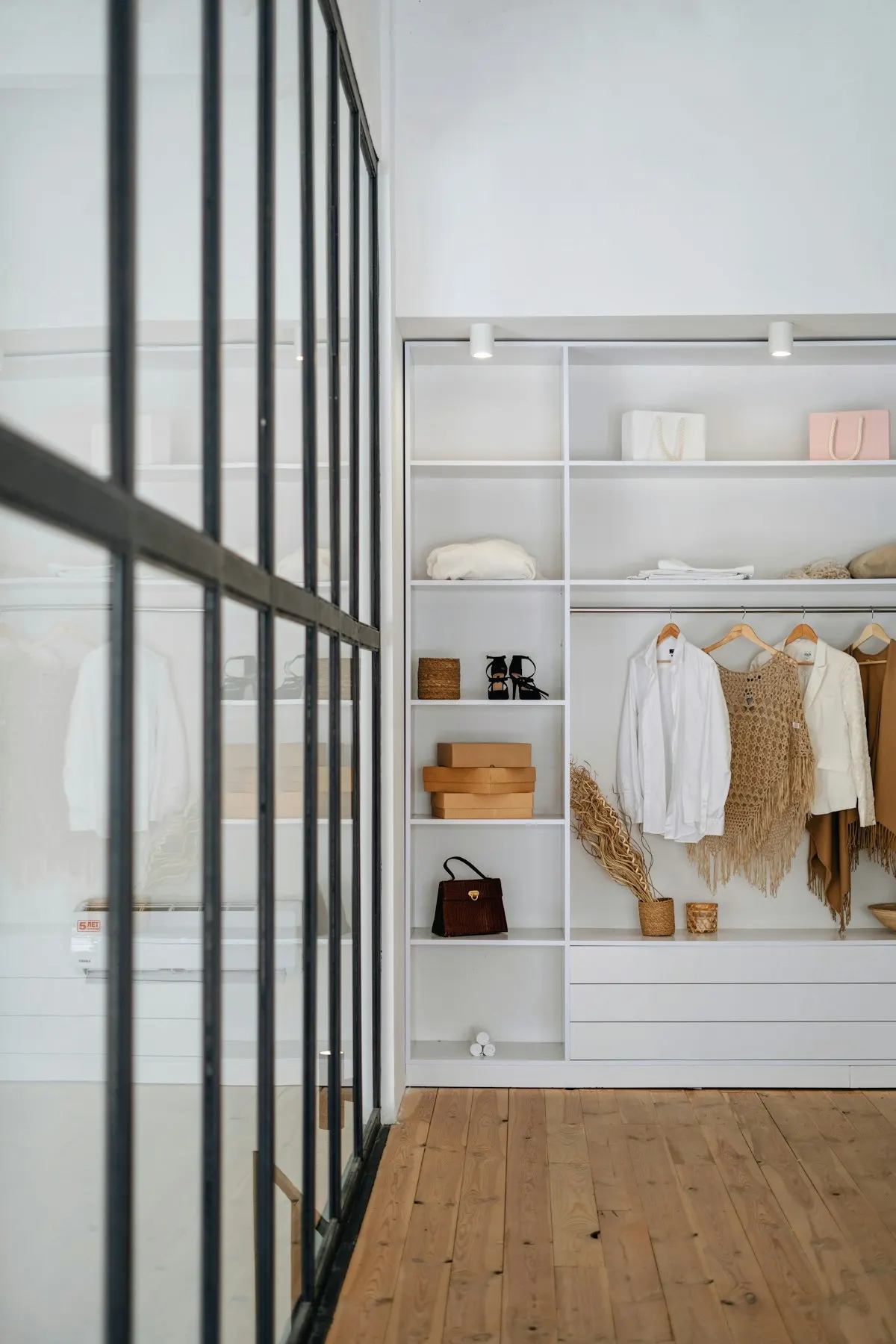
Wire costs less upfront and little to maintain; both sit inside Angi's installed band of $50–$150 per linear foot, with wire at the low end. Over time, shelves may sag slightly and coatings may chip, but replacement parts are inexpensive. Laminate costs more upfront and, kept dry, needs even less maintenance; slides and hinges may need adjustment. Neither material typically needs replacing within ten years. The long-run difference is therefore close to the upfront difference, plus any furniture you avoid buying because laminate drawers replace a dresser.
That dresser point matters. Angi prices a wardrobe organizer at $1,200–$3,500. If a laminate drawer tower lets you remove a dresser from the bedroom, the effective cost gap narrows and the bedroom gains floor space. If the closet needs no drawers, wire's cost advantage stands. Use the cost calculator to price your footage at both tiers before deciding. Measure the dresser's drawer volume before the design visit so the installer can size the tower to replace it.
In humid climates and in closets near bathrooms or laundries, humidity is the main enemy of laminate. The particleboard core swells where edges are unsealed, and once swollen it does not recover. Edge banding on every exposed edge largely solves this, and good installers band edges as standard. Wire is immune to swelling, which is why it remains the default in many humid-region homes and utility spaces. A small gap between panels and an exterior wall also helps air move.
In dry climates both materials work well. In cold climates, closets on exterior walls can see condensation, and wire's open design lets air reach the wall. Whichever you choose, keep the bottom of laminate panels off a floor that may get wet. The closet systems page covers moisture and ventilation in more detail. In coastal homes, choose epoxy-coated wire over vinyl coatings, which chip and rust sooner in salty air.
Wire's failures are sagging under heavy loads, marks on knits, small items falling through, and anchors pulling out of drywall. Liners, closer shelf supports and anchoring rails to studs prevent all four. Laminate's failures are shelf sag on long spans, swelling at unbanded edges, drawer slides wearing out and panels pulling off walls when anchored poorly. Proper span limits, full edge banding, rated slides and stud anchoring prevent them.
Both materials fail most often through overloading and poor installation rather than through the material itself, which is why HomeGuide's 4–16 hours labor range matters as much as the material line. A well-installed wire closet outlasts a poorly installed laminate one. When comparing installers, ask about anchoring, maximum shelf span and slide ratings as carefully as you ask about finish. Put those three questions in writing so the answers can be compared across bids.
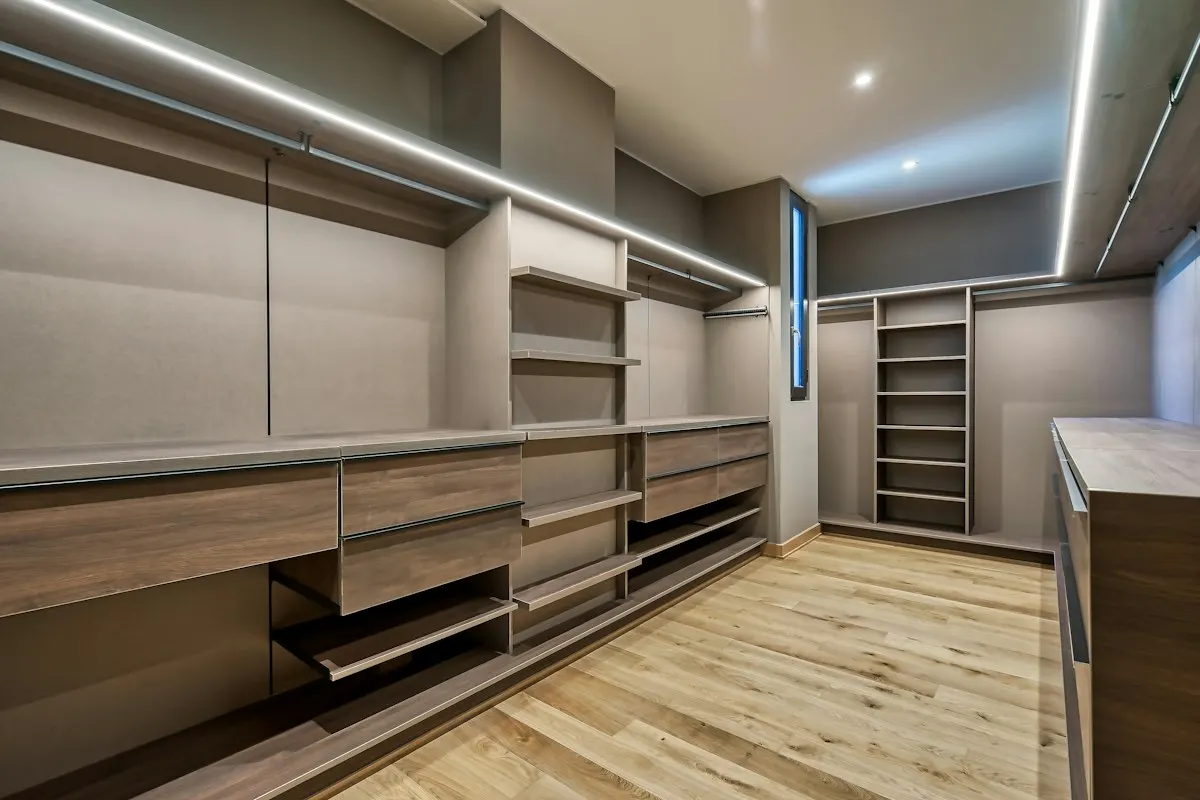
Compare them on capacity for your inventory, not only on price. Ask each installer to show how the design holds your rod inches, folded stacks and shoes. Then compare what is included: shelving, rods, drawers or baskets, installation, liners and removal of old shelving. Wire bids often exclude liners and basket drawers; laminate bids often exclude lighting and specialty accessories. Ask each bidder to note shelf spans and slide ratings on the drawing too.
Consider a mixed design. A laminate drawer tower and hanging section on the main wall, with wire shelves on the sides and above rods, often gives the function of laminate for much less money, closer to the middle of Angi's $627–$2,526 typical range than the top. Ask for that version specifically. The custom versus prefab comparison covers the related question of whether the laminate should be custom or modular. Independents are usually more willing to mix materials than brand showrooms.
Walk through a typical three-bedroom house and the answer changes room by room. The primary closet usually suits laminate, since it holds the most clothing, gets used twice a day and benefits from drawers. Children's closets suit wire for the first ten years, because rod heights and contents change constantly. The linen closet near the bathroom suits wire for ventilation. The hall coat closet suits either, with wire usually winning on cost.
The laundry room and the pantry split the other way. A laundry room sees humidity and wet items, which favors coated wire or sealed shelving. A pantry holds cans and jars that tip on wire, which favors laminate. Pricing each closet separately, rather than one material for the whole house, typically lowers the total without losing function. The closet cost guide shows how to split a whole-house quote by closet.
Homeowner polls
Angi prices wire organizers at $800–$2,000 and laminate at $1,200–$3,500 installed.
No votes yet. Yours will be the first. · saved on this device
Angi's 2026 custom closet average is $2,128.
No votes yet. Yours will be the first. · saved on this device
Yes, and it is a common money-saver: a laminate drawer tower and hanging section on the main wall with wire shelving on the returns and above the rod. Ask the installer to draw it that way; brand systems are less flexible about mixing than independents.
It leaves lines on soft knits and lets small items fall through. Shelf liners fix both for a few dollars. For folded jeans and T-shirts it is fine. For sweaters and anything delicate, a flat laminate shelf or a liner is worth it.
It helps air circulate, which reduces the chance of mildew in humid closets, but it does not fix a moisture problem. If a closet smells musty, address the source first: ventilation, a leak or condensation on an exterior wall. Then choose the shelving.
Only if supported closely. Wire shelves sag under concentrated weight over long spans. For books, tools or heavy stacks, add supports or use laminate or solid shelving. Check the manufacturer's load rating and the spacing of the supports. A laminate shelf of the same length usually carries more.
New particleboard can emit a faint odor for a short time. Many manufacturers now use low-emission boards meeting formaldehyde standards. Ask for the board's emission certification if this matters, and ventilate the closet for a few days after install. Wire has no such concern.
Wire, especially track-mounted systems, is easier: one rail into studs and components that hang from it. Laminate systems are heavier, need careful leveling, and custom laminate is cut to size by the maker. Modular laminate kits are manageable for a confident DIYer with a helper.
You can, with a paint suited to metal, but the finish chips with use and the result rarely matches a factory coating. Replacing shelves with a new color is often easier and cheaper than painting them in place. Liners are another way to change the look without paint.
 ComparisonCustom closet system vs Prefab closet system
Choose custom for the primary closet, where drawers, doors and a scribed fit are used daily and NAR estimates 83% cost recovery at resale.
 ComparisonOverhead racks vs Wall track, slatwall, and shelving
Put items used weekly on the wall, and seasonal bins on overhead racks.
 ComparisonWalk-in pantry vs Pantry cabinets in the kitchen
Choose a walk-in pantry if you have or can create 20 square feet or more near the kitchen, cook often and store small appliances; shallow shelves on three walls hold more per dollar.
 ComparisonMudroom addition vs Conversion or built-in in existing space
Most households get what they need from a built-in in the existing entry or a conversion of a garage corner, laundry or porch, at a fraction of an addition's cost.
 Service guideCustom Closet Systems
A custom closet system is shelving, rods, drawers, and doors cut and installed to the dimensions of your closet and the contents of your wardrobe.
 Service guidePantry Organization
Pantry organization is the planning and fitting of a food closet, walk-in pantry, or pantry cabinet so everyday items are visible and reachable and bulk items and appliances have a place.
 Service guideGarage Storage Solutions
Garage storage covers wall systems, cabinets, shelving, and overhead racks that hold tools, bikes, bins, and seasonal gear while leaving room to park and move.
 Service guideMudroom Built-Ins
Mudroom built-ins are the bench, cubbies, hooks, drawers, and cabinets that give each household member a place for coats, bags, and shoes at the door.
 Free toolStorage cost calculator: price the system by the linear foot
Size, material tier and complexity in, a realistic budget range out.
 Free toolHow well do you understand storage pricing and design?
9 questions that show what you already know and what to check next.
 Free toolPolls: how other homeowners handle storage
See what other planners chose and add your vote.
Tell us the size, the condition of what is there now, and what you want to change. Closet Flow Guide passes your request to independent local professionals, who reply with written, no-obligation estimates. The service is free to use.