Can you park every vehicle inside your garage today?
A Craftsman survey found 36% of Americans cannot park in their garage.
No votes yet. Yours will be the first. · saved on this device
Loading...
Closet Flow Guide · Service guide
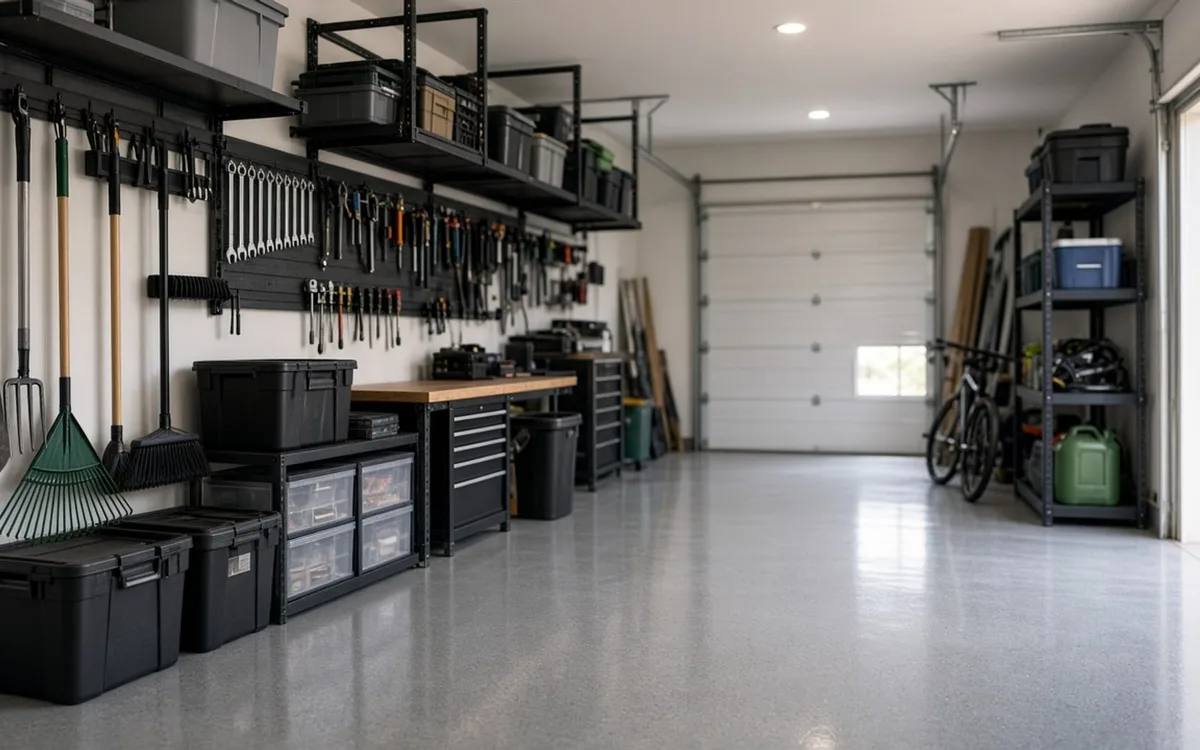
Garage storage covers wall systems, cabinets, shelving, and overhead racks that hold tools, bikes, bins, and seasonal gear while leaving room to park and move. It suits a homeowner who has listed what needs storing, with weights, and knows the wall and ceiling construction. Fixr's 2025 data puts a professionally installed medium-garage system at $3,500, with cabinets from about $505 to $2,164 each per Angi.
The garage is the largest storage space most houses have and the one most often lost. A 2022 CRAFTSMAN survey found 36% of Americans can no longer park a vehicle in their garage and 62% call it the most cluttered space in the home. Our analysis of the federal government's 2024 household survey (the EIA's RECS) finds an attached garage in 42.9% of occupied U.S. homes: a two-car garage in 27.8%, a one-car in 9.2%, and three or more bays in 6.0%. That is a lot of square footage holding bins on the floor.
Garage storage differs from closet work in one important way: the loads are real and the failures are dangerous. An overhead rack over a car, a cabinet full of paint and tools, a bike lift, a wall of slatwall carrying a ladder: each needs anchors into framing and product ratings that match the weight. This page covers the inventory with weights, the three main storage types and their published prices, the anchoring and clearance checks, and how to plan a garage that still parks two cars. If the floor is being coated, do that first; the services hub explains sequencing.
Want the numbers only? Read the garage storage solutions cost guide for 2026 ranges, what moves the price, and sample budgets.
| Item | Low | High | Unit | Notes |
|---|---|---|---|---|
| Whole medium garage system, installed | $2,500 | $5,000 | per garage | Fixr 2025; $3,500 average |
| One-car garage system, installed | $650 | $5,100 | per garage | Fixr 2025; prefab low to custom high |
| Two-car garage system, installed | $2,150 | $8,450 | per garage | Fixr 2025; prefab low to custom high |
| Three-car garage system, installed | $2,500 | $13,000 | per garage | Fixr 2025; prefab low to custom high |
| Garage cabinet, installed | $505 | $2,164 | per cabinet | Angi 2026; $2,000–$5,000 two-car package |
| Slatwall or track rails | $75 | $1,250 | per garage | Fixr 2025; prefab to custom |
| Overhead rack, materials | $75 | $400 | per rack | Fixr 2025 prefab |
| Workbench | $150 | $1,500 | each | Fixr 2025 prefab |
| Organizer service labor | $55 | $75 | per hour | Angi 2026 |
| Old cabinet removal | $300 | $300 | flat | Angi 2026 |
| Professional organizer, garage | $1,000 | $2,500 | per garage | Fixr 2025; Angi $300–$1,200 |
Anyone parking outside because of what is inside, anyone renting a storage unit for garage-type items, and anyone with a growing family's worth of bikes, sports gear, and holiday bins. NAHB's buyer study found 81% of home buyers rate garage storage essential or desirable, one of only 13 features above 80%. The CRAFTSMAN survey found 52% of garage owners are unsatisfied with how theirs is organized and 90% believe good organization makes a small garage feel larger.
It is a weaker buy for a garage that is about to become a workshop, a gym, or living space; plan that use first and store around it. It is also premature if the walls are unfinished, the slab is being coated, or a water heater or panel relocation is planned, because storage bolted to walls has to come off for all of those.
List everything by category with a rough weight and a frequency: bikes (25 to 50 pounds each, weekly), bins (30 to 60 pounds each, seasonal), ladders, tools, lawn equipment, sports gear, camping gear, paint and chemicals, and the second refrigerator. Our RECS analysis puts one in the garage of 15.1% of U.S. homes (18.3% in the West) and of 32.0% of owner-occupied homes with an attached garage. Then measure the cars with doors open and the path from car door to house door. That path and the door swings are the space you cannot fill.
Weights decide the product. A prefab overhead rack rated for 600 pounds is fine for holiday bins and camping gear and wrong for a canoe plus lumber. A wall track rated for 50 pounds per hook holds a bike and fails under a ladder and a pressure washer on adjacent hooks. Angi notes garage organizer services bill $55 to $75 an hour, and the hour spent placing weights on the drawing is the cheapest insurance in the project. If the garage is too full to list, an organizer at HomeAdvisor's $55–$100 per hour sorts it first. The inventory sheet has a garage version with weight columns.
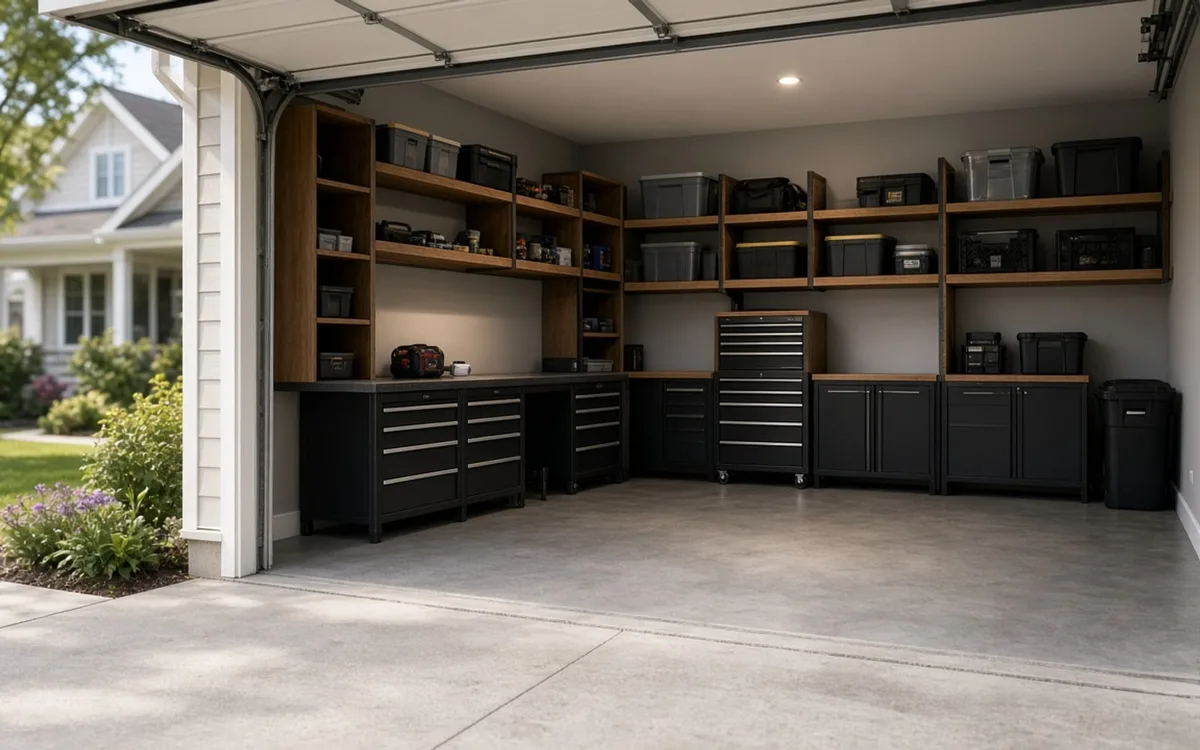
Fixr's 2025 guide prices a complete medium-garage system with workbench, shelves, cabinets, hooks, and overhead storage at $3,500 and gives a materials-only comparison of $2,300–$6,300 for prefab versus $2,900 to $8,200 custom across a whole garage. Slatwall rails run $75 to $1,000 prefab or $325 to $1,250 custom; a workbench $150 to $1,500 prefab; prefab overhead racks $75 to $400 in materials.
Cabinets are the expensive, tidy option. Angi prices installed garage cabinets at $505–$2,164, or $2,000 to $5,000 for a two-car garage package, with old-cabinet removal about $300. They hide chemicals and tools from children and dust, and they cost several times what open shelving costs per cubic foot. Most garages do best with a mix: track or slatwall for bikes, tools, and ladders; open steel shelving for bins; one or two cabinets for chemicals and valuables; overhead racks for seasonal gear above the hood of the car.
| System | Published range | Best for | Watch for |
|---|---|---|---|
| Wall track or slatwall | $75–$1,250 rails | Bikes, tools, ladders, hoses | Per-hook ratings, stud spacing |
| Steel shelving units | Included in $2,300–$6,300 prefab | Bins, coolers, bulk | Anchor to wall; 24-in depth max |
| Cabinets, installed | $505–$2,164 each | Chemicals, valuables, tools | Cost per cubic foot; wall anchoring |
| Overhead racks | $75–$400 materials | Seasonal bins, camping gear | Joist versus truss; clearance above car |
| Workbench | $150–$1,500 prefab | Projects, repairs | Light and outlet placement |
| Whole medium garage | $2,500–$5,000 | Complete system | Fixr 2025; $3,500 average |
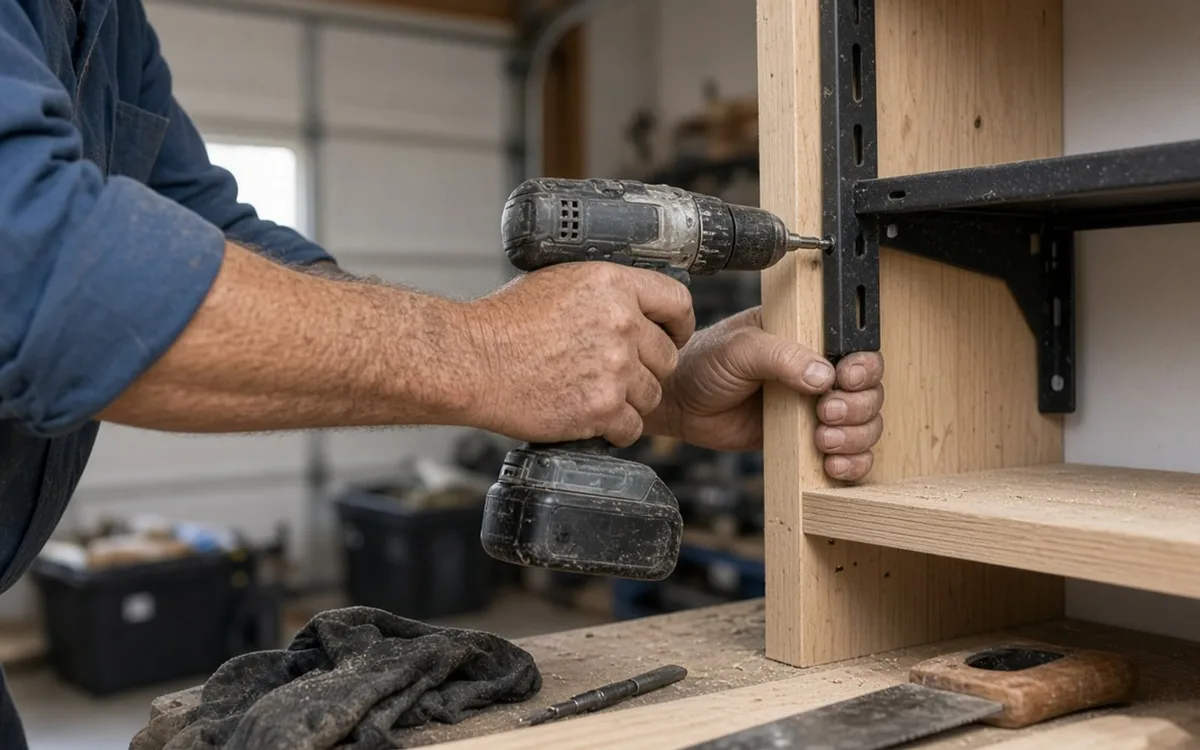
Into framing, always, for anything carrying real weight. Wall tracks lag into studs at 16 or 24 inches; on block walls they use masonry anchors and a hammer drill. Overhead racks bolt through ceiling drywall into joists or truss bottom chords, and the difference matters: trusses are engineered assemblies, and some manufacturers and many building departments limit what can hang from a bottom chord. Ask the installer how they will find and confirm the framing and what the rack's rating is, then load it to no more than two-thirds of that.
Cabinets hang on a French cleat or a rail into studs and should never sit on a slab that gets wet; legs or a raised base keep particleboard off the floor. Shelving units get a wall strap so they cannot tip. The site data's checkpoint for this scope says it plainly: have supports and product load limits checked before using overhead storage. That is not a formality in a room where a car and a child are directly below.
Draw the car footprints on the floor plan with doors open, then the path to the house door, then the garage door track and opener. What is left is the storage envelope: the walls above hood height, the side walls outside the door swing, the ceiling above the hood and in front of the garage door track, and the back wall. By our RECS count, a two-car garage is in 27.8% of U.S. homes; in most of them one bay is lost to bins that could hang on one wall.
Overhead racks go above the hood, not above the doors, and need at least the car's height plus a few inches. Wall tracks go at the front corners for bikes and at the back for tools, leaving the side walls at door height clear. The mower, stroller, and cooler get a marked floor zone. A garage that keeps both cars, moves gear off the floor, and still has a workbench is a layout problem first and a product problem second, which is why the overhead versus wall storage comparison starts with the floor plan.
Overloaded racks and hooks are the serious failure. Then cabinets standing in a wet corner and swelling, shelving in front of the panel or water heater, an overhead rack that blocks the opener's travel, and a wall system that fills the side wall so the car door cannot open. The cheap failure is buying a system for the garage you wish you had: a wall of cabinets for a workshop that is really a bike and bin room.
Sequencing errors are common too. Storage installed before a floor coating has to come off; storage installed before insulation and drywall gets rebuilt. If any of those are planned within a year or two, do them first. The reviews page shows how homeowners describe installers who handled the clearances well and the ones who did not.
Humid and coastal garages need powder-coated steel, sealed cabinets, and nothing paper on the floor; salt air rusts cheap hooks in a season. Cold-climate garages store snow gear and a second refrigerator, which our RECS analysis finds in the garage of 14.5% of Midwest homes, and need the fridge near an outlet and away from the door. Hot-climate garages get to 120°F, which is hard on paint, adhesives, and anything electronic on an overhead rack. Seismic regions should strap shelving and cabinets and prefer wall storage to overhead. The locations page has regional garage counts from RECS.
Check that each drawing keeps both cars and the path, then compare load ratings and anchoring methods before price. A $3,000 quote with rated overhead racks lagged into joists and a French-cleat cabinet run is a different product from a $2,200 quote with racks screwed into drywall. Compare with Fixr's $2,500 to $5,000 whole-garage range and Angi's per-cabinet band. Ask what the installer does when the ceiling turns out to be trusses; a specific answer means they have met the problem before. The request form sends your inventory with weights to independent pros for written estimates.
Closet Flow Guide ran these numbers on the federal government's own household data. You won't find them in a contractor's brochure.
Closet Flow Guide analysis · 2024
95% interval 30.5%–33.5% · about 16.6 million homes · 7,070 survey households
About one in three homes with an attached garage keeps a second refrigerator there. Plan a dedicated outlet, a level pad and a floor coating that tolerates condensation where it will stand.
Source: Closet Flow Guide analysis of 2024 federal household survey data from the U.S. Energy Information Administration. How we calculated it
Homeowner polls
A Craftsman survey found 36% of Americans cannot park in their garage.
No votes yet. Yours will be the first. · saved on this device
No votes yet. Yours will be the first. · saved on this device
No votes yet. Yours will be the first. · saved on this device
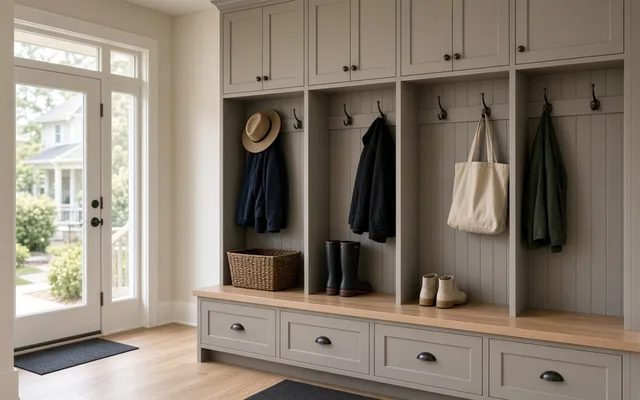 Service guideMudroom Built-Ins
Mudroom built-ins are the bench, cubbies, hooks, drawers, and cabinets that give each household member a place for coats, bags, and shoes at the door.
 Service guideCustom Closet Systems
A custom closet system is shelving, rods, drawers, and doors cut and installed to the dimensions of your closet and the contents of your wardrobe.
Often, with limits. Truss bottom chords are designed for ceiling loads and some manufacturers and building departments restrict point loads on them. Installers spread the load across several trusses with a header or use racks designed for truss mounting, and keep the rating conservative. Ask for the rack's rating, how it is attached, and whether the installer has checked truss guidance for your house. A joist ceiling is simpler.
Above the car door swing on the side walls, about 42 to 48 inches, and above the hood on the front wall. The lower wall stays clear so doors open and people walk through. Bikes hang vertically from the front wall with the rear wheel above bumper height. Anything used daily, such as a stroller or cooler, gets a floor zone rather than a hook.
For chemicals, tools, and anything you want out of sight or away from children, yes. For bins and bulk, open steel shelving holds more per dollar and shows what is in it. Angi's $505 to $2,164 per cabinet installed compares with a few hundred dollars for a heavy-duty shelving unit. Most garages do best with two or three cabinets and shelving for the rest.
Near an outlet, away from the garage door and direct sun, with clearance behind for airflow, and off the path to the house. Garage refrigerators struggle in unconditioned spaces below about 50°F or above 100°F; a garage-rated model handles it. Plan storage around the fridge's footprint and door swing; it is the largest fixed object in most garages.
Not necessarily. Track systems and shelving can mount to bare studs, and some homeowners prefer it because the studs are visible. Cabinets look better on drywall and need it for a clean fit. If insulation and drywall are planned, do them first; everything bolted to the wall comes off for that work.
Before. An epoxy or polyaspartic coating needs an empty slab for grinding and curing, and storage installed on or against the floor has to come out. Coat the floor, wait for full cure, then install storage on legs or wall-hung so the coating can be cleaned underneath.
Whatever the manufacturer rates it for, only when the track is lagged into studs. Typical ratings run 25 to 75 pounds per hook and a few hundred per rail section. A bike is 25 to 50 pounds, a ladder 30 to 50, a pressure washer 50 to 80. Add up adjacent hooks against the rail rating; the rail fails before the hooks do.
Rarely for more than a year or two. SpareFoot puts the average 10x10 unit at $119 a month, roughly $1,400 a year, and PwC reports 13.4% of households rent one, with about 60% staying more than a year. A $3,500 garage system that empties a unit pays for itself in about two and a half years and adds a feature 81% of buyers want.
 Free toolStorage cost calculator: price the system by the linear foot
Size, material tier and complexity in, a realistic budget range out.
 Free toolWhich storage option fits? Comparisons with sourced numbers
Side-by-side tables for the decisions that change the price most.
 Free toolHow well do you understand storage pricing and design?
9 questions that show what you already know and what to check next.
 Free toolPolls: how other homeowners handle storage
See what other planners chose and add your vote.
Tell us the size, the condition of what is there now, and what you want to change. Closet Flow Guide passes your request to independent local professionals, who reply with written, no-obligation estimates. The service is free to use.