Which garage storage would you add first?
No votes yet. Yours will be the first. · saved on this device
Loading...
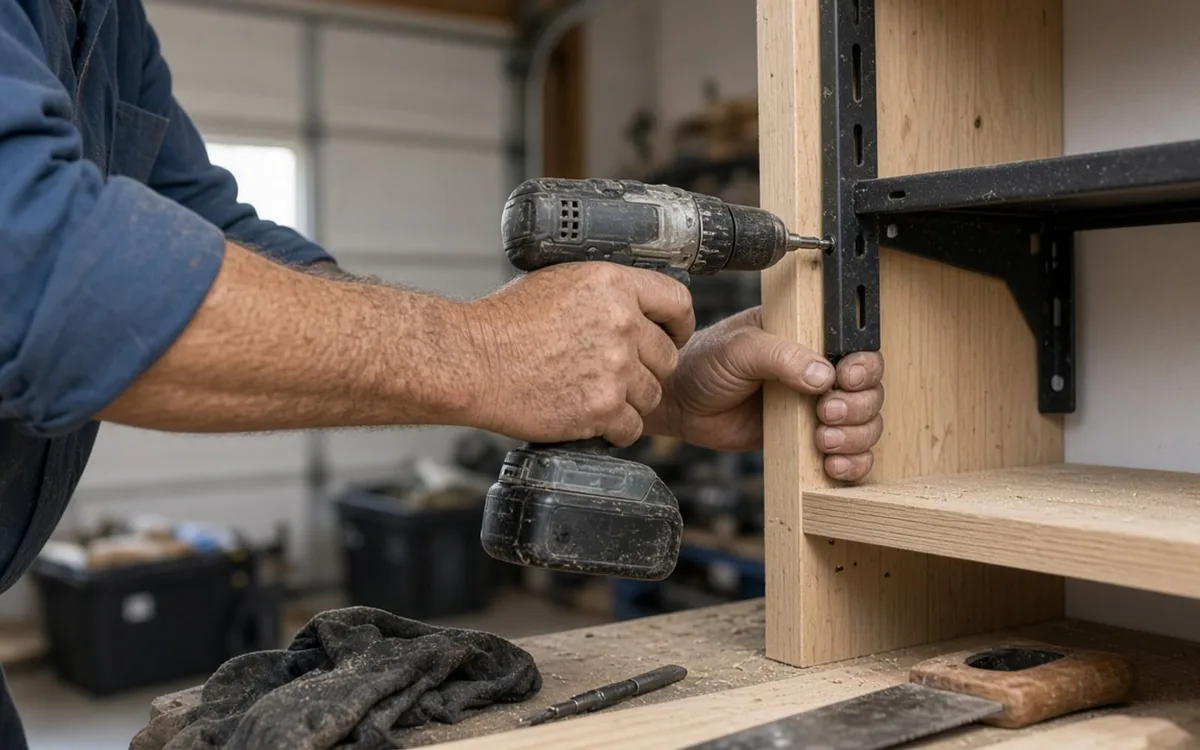
Closet Flow Guide · Garage Storage Solutions cost guide
Fixr puts the average professionally installed garage system at about $3,500, with whole-garage prefab materials at $2,300 to $6,300 and custom at $2,900 to $8,200. By size, Fixr prices an installed two-car system at $2,150 to $8,450 from prefab to custom. Angi prices installed cabinets at $505 to $2,164 each, so the cabinet count moves the total more than the garage size does.
Garage storage covers a wide range, from a few hooks and a shelf to a fully fitted garage with cabinets, slatwall, overhead racks and a workbench. The cost depends on which elements you choose and how many, more than on the size of the garage. Cabinets are the expensive element; open wall systems and overhead racks are relatively inexpensive and hold most of what a typical garage contains.
This page covers ranges by element, the three common tiers, add-ons worth paying for, the labor share, phasing, what to cut first and sample budgets for one- and two-car garages. The cost table and calculator further down show the published line items, so the text here focuses on how to combine them into a plan that fits the budget.
| Item | Low | High | Unit | Notes |
|---|---|---|---|---|
| Whole medium garage system, installed | $2,500 | $5,000 | per garage | Fixr 2025; $3,500 average |
| One-car garage system, installed | $650 | $5,100 | per garage | Fixr 2025; prefab low to custom high |
| Two-car garage system, installed | $2,150 | $8,450 | per garage | Fixr 2025; prefab low to custom high |
| Three-car garage system, installed | $2,500 | $13,000 | per garage | Fixr 2025; prefab low to custom high |
| Garage cabinet, installed | $505 | $2,164 | per cabinet | Angi 2026; $2,000–$5,000 two-car package |
| Slatwall or track rails | $75 | $1,250 | per garage | Fixr 2025; prefab to custom |
| Overhead rack, materials | $75 | $400 | per rack | Fixr 2025 prefab |
| Workbench | $150 | $1,500 | each | Fixr 2025 prefab |
| Organizer service labor | $55 | $75 | per hour | Angi 2026 |
| Old cabinet removal | $300 | $300 | flat | Angi 2026 |
| Professional organizer, garage | $1,000 | $2,500 | per garage | Fixr 2025; Angi $300–$1,200 |
Fixr's 2025 garage organizer guide prices installed systems by garage width, with separate prefab and custom bands. A medium two-car garage runs $2,150–$8,450 across both, and the overlap between the columns is wide: a well-specified prefab system in a large garage can cost more than a modest custom one in a small garage. Within any row, the number of cabinets decides where you land.
Fixr also lists the items that often ride along with a storage install: a light fixture at $165 to $195, a new outlet at $120 to $200, electrician time at $40 to $120 per hour, and an epoxy floor at $2,230 to $4,015 for a 20 by 24 foot garage. Price those as separate lines so you can see what the storage itself costs.
| Garage size (Fixr 2025) | Prefab system, installed | Custom system, installed |
|---|---|---|
| Small: 12–16 ft wide, one car | $650–$3,900 | $750–$5,100 |
| Medium: 22–26 ft wide, two cars | $2,150–$6,500 | $2,400–$8,450 |
| Large: 32 ft+ wide, three cars | $2,500–$10,000 | $3,450–$13,000 |
Fixr's average for a professionally installed garage system is $3,500, with whole-garage packages at $2,300–$6,300. Angi puts installed cabinets at $505–$2,164 each and a two-car cabinet package at roughly $2,000 to $5,000. Those two sources together show that cabinets account for most of the spread between a modest and a fully fitted garage. Knowing that makes it easier to decide how many cabinets you really need.
Open storage costs far less. Fixr prices rails from roughly $75 to $1,250 depending on prefab or custom, overhead racks roughly $75 to $400 each in materials, and workbenches from roughly $150 to $1,500. A garage built mostly from rails, shelving and two racks can land well under the average. The overhead versus wall comparison explains which items belong on each.
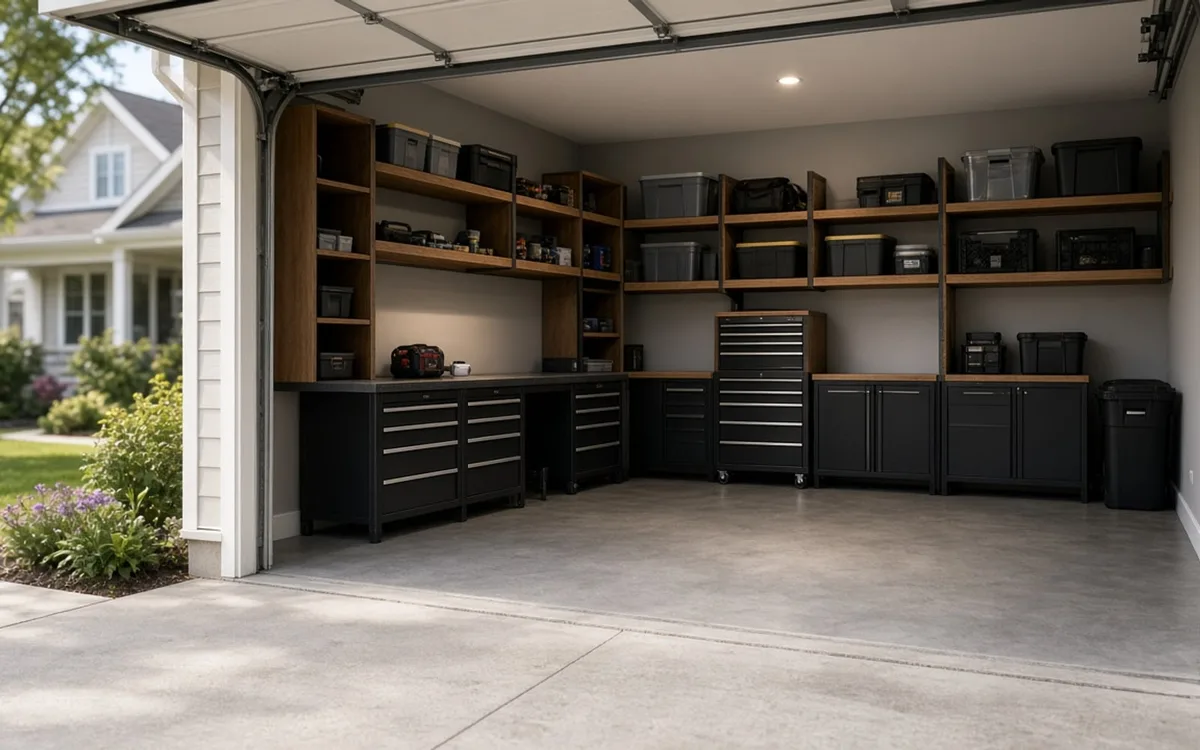
Entry tier is open shelving, basic track rails, hooks and a prefab overhead rack. Mid tier adds slatwall or heavier track, more racks, a workbench and a few cabinets where closed storage is needed. Upper tier is a fully fitted garage with cabinet runs along one or more walls, slatwall throughout and sometimes coordinated flooring and lighting. Each step up adds more cost through cabinets than through anything else.
Most garages get the most function per dollar from the entry and mid tiers. Cabinets add closed storage and a finished look but cost much more per foot of wall than open shelving. Choose cabinets where closed storage actually matters: chemicals, fertilizer, valuables and anything to keep away from children, pests or dust. Bins, sports gear and tools usually do fine on open shelving and rails.
Product round-ups rank garage brands, but the choice that sets cost and function is the system type: track rails, slatwall panels, steel or plastic shelving units, welded or modular cabinets, and fixed or motorized overhead racks. Compare load ratings per hook and per rack, whether later accessories fit the same rail, and how each piece anchors to your wall type. A brand name tells you less than those three answers.
| Tier | Typical elements | Main cost driver |
|---|---|---|
| Entry | Shelving, track rails, hooks, one rack | Footage of rail and number of racks |
| Mid | Slatwall or heavy track, racks, workbench, a few cabinets | Cabinet count |
| Upper | Full cabinet runs, slatwall, coordinated finishes | Cabinet runs and finish |
Worth paying for: a locking cabinet for chemicals, well-anchored bike hooks or a floor rack for heavy e-bikes, a workbench if you do projects, and better overhead lighting so the storage is usable after dark. Ceiling lifts are worth it if you want to avoid ladders for seasonal bins. Outlets near the workbench are useful but bring an electrician and possibly a permit, so price them separately. Ask for these as separate lines so they are easy to drop or defer.
Less essential: matching accessory kits, decorative finishes and cabinets for items that could sit on open shelves. Plan around fixed items rather than paying to move them. Our analysis of the EIA's 2024 household survey found 15.1% of homes keep a second refrigerator in the garage, and the storage layout should leave it room to ventilate and keep its outlet reachable. Leave space for a chest freezer if one is planned.
Labor is a larger share in garages than in closets. Angi's cost table lists organizer service labor around $55 to $75 per hour for garage work. Anchoring into concrete block, lifting heavy cabinets, assembling overhead racks and working around parked cars all take time. Angi also lists removal of old cabinets at around $300 as a flat line, which is easy to miss when comparing bids.
Clearing the garage first can be its own line item. Fixr's cost table places a professional garage organizing project at roughly $1,000 to $2,500, and Angi's at roughly $300 to $1,200. Clearing first often shows that less storage is needed than expected, which can reduce the installation bill by more than the organizer costs. Ask installers whether they expect an empty garage on install day.
Phasing spreads cost and often lowers it, because each phase shows what is still needed. Start with wall rails and shelving for items used weekly. Add overhead racks for seasonal bins once you see what remains on the floor. Add cabinets last, only where closed storage is needed. Keep one rail system throughout so later hooks and baskets fit, and leave wall space in the first phase for the later ones.
Timeline matters less for garages than closets because most components are in stock at retailers and installers. Custom cabinets are the exception and can carry lead times of several weeks. Scheduling in a slower season may be easier. Delay does not usually save money, but avoiding rushed decisions does, since mistakes in garages tend to be expensive cabinets in the wrong place. Book the install for a dry day if cars will be parked outside.
Cut cabinets first, replacing some with open shelving and clear bins. Next, reduce decorative finishes and matching accessory kits. Keep anchoring quality, overhead rack ratings, adequate load capacity for heavy items and a layout that keeps car doors and walkways clear. Those items prevent the failures that cost the most, including a rack falling onto a car or a rail pulling out of a wall.
Avoid cutting the sort. CRAFTSMAN found 36% of Americans cannot park inside because of clutter, and much of that clutter does not need storing at all. Sorting, donating and weighing the heavy items before any quote is the cheapest step in the project. The planning guide explains how to inventory a garage before buying storage. Fewer items means fewer racks and less wall to fit out.
A one-car garage with track rails, hooks, a shelving unit and one overhead rack typically stays in the lower half of Fixr's $650 to $3,900 prefab band for that size. A two-car garage with slatwall on the back wall, two overhead racks, a workbench and two cabinets typically lands near Fixr's $3,500 average. A fully fitted two-car garage with cabinet runs on two walls reaches the top of Fixr's two-car range of $2,150–$8,450, largely because of the cabinets.
Compare that one-time cost with renting space elsewhere. SpareFoot's 2026 average for a 10x10 self-storage unit is $119 per month, paid every month for as long as the unit is kept. A garage system that lets you close the unit pays for itself within a few years. The garage storage page and the calculator help size your own budget. Sorting first usually makes the numbers look even better.
By the numbers
Planning figures from published U.S. sources; every card links to where the number came from.
$3,500
national average for a professionally installed garage organizer system
Fixr's $2,500 to $5,000 range describes a medium garage with workbench, shelves, cabinets, hooks, and overhead storage. Prefab overhead racks cost $75 to $400 in materials; custom cabinets $200 to $8,000.
Fixr, How much does it cost to install a garage organizer system? (2025)$2,150–$8,450
installed organizer system for a medium two-car garage (22–26 ft wide), prefab low end to custom high end
Fixr prices the two-car garage at $2,150 to $6,500 prefab and $2,400 to $8,450 custom, against $650 to $5,100 for a one-car and $2,500 to $13,000 for a three-car garage.
Fixr, How much does it cost to install a garage organizer system? (2025)$2,300–$6,300
whole-garage prefab storage materials versus $2,900–$8,200 custom
Fixr's materials-only comparison also prices slatwall rails at $75 to $1,000 prefab or $325 to $1,250 custom and a workbench at $150 to $1,500 prefab. Most garages do best with a mix.
Fixr, How much does it cost to install a garage organizer system? (2025)$505–$2,164
installed cost per garage cabinet; $2,000–$5,000 for a two-car package (2026)
Angi also reports garage organizer services at $55 to $75 an hour and old-cabinet removal at about $300. Cabinets suit chemicals and valuables; open shelving holds bins better per dollar.
Angi, How Much Do Garage Cabinets Cost? [2026 Data] (2026)The calculator uses the same closet and home organization benchmarks as this guide. Set the size and tier, then request a written estimate to check it against a real proposal.
Homeowner polls
No votes yet. Yours will be the first. · saved on this device
A Craftsman survey found 36% of Americans cannot park in their garage.
No votes yet. Yours will be the first. · saved on this device
For chemicals, valuables and a finished look, yes. For bins, sports gear and tools, open shelving and rails hold more for much less. Most garages benefit from a few cabinets placed where closed storage matters, such as beside the workbench or the house door, rather than full runs along every wall.
Fixr prices prefab racks at roughly $75 to $400 each in materials. Installation adds labor, and more of it on truss ceilings, where the load has to be spread across several members. Motorized or pulley lifts cost more than fixed racks but avoid ladders. Confirm the published load rating on any rack before you buy it.
Usually, per foot of wall, because slatwall covers the whole surface while track uses rails at intervals. Track systems cost less and go up faster, and they handle concentrated loads well when lagged into studs. Choose slatwall for a finished-looking garage and track for a working garage where cost and flexibility matter more.
NAHB's 2024 survey found 81% of buyers rate garage storage essential or desirable, so an organized garage shows well at sale. Full cabinet runs are unlikely to be recovered in the price, but sensible wall storage and racks that let a car park inside make the garage read as usable space to buyers.
If a coating is planned, do the floor first and the storage second, since cabinets and floor racks are hard to work around. Coordinating the two avoids moving everything twice. Floor coatings are a separate budget, which Fixr puts at $2,230 to $4,015 for epoxy in a 20 by 24 foot garage, with their own drying time, so schedule the storage install after the coating has fully cured.
Many homeowners install rails, hooks and shelving themselves, and labor is a meaningful share of garage bids. Overhead racks and cabinets need two people, careful anchoring and attention to load ratings. Hire a pro for concrete block walls or truss ceilings if you are unsure of the framing or the right fasteners.
In the short term, possibly. Over a few years, monthly rent at SpareFoot's 2026 average for a 10x10 unit usually exceeds the cost of a sensible garage system, and the rent never stops. Sorting the contents first often shows that much of what is in the unit can go, which lowers both costs.
 Custom Closet Systems · Cost guideHow much a custom closet costs in 2026, and where the money goes
Angi's 2026 data puts the average custom closet at $2,128, with most projects between $1,046 and $3,210, and installed organizers at $50 to $150 per linear foot.
 Pantry Organization · Cost guideWhat pantry organization costs in 2026, from a hall closet to a walk-in
Angi's 2026 data puts pantry organizer systems at $1,000 to $3,000 installed and a custom pantry at an average of $2,000, with reach-in fit-outs from about $250.
 Mudroom Built-Ins · Cost guideWhat a mudroom built-in costs in 2026, from bench and hooks to an addition
A prefab bench and hook wall costs a few hundred dollars installed, a custom painted built-in in an existing entry costs more depending on length and drawers, conversions run $50 to $100 per square foot per Angi, and a mudroom addition averages $12,000.
 Service guideGarage Storage Solutions
Garage storage covers wall systems, cabinets, shelving, and overhead racks that hold tools, bikes, bins, and seasonal gear while leaving room to park and move.
Service guideMudroom Built-InsMudroom built-ins are the bench, cubbies, hooks, drawers, and cabinets that give each household member a place for coats, bags, and shoes at the door.
Service guideCustom Closet SystemsA custom closet system is shelving, rods, drawers, and doors cut and installed to the dimensions of your closet and the contents of your wardrobe.
 Free toolStorage cost calculator: price the system by the linear foot
Size, material tier and complexity in, a realistic budget range out.
 Free toolWhich storage option fits? Comparisons with sourced numbers
Side-by-side tables for the decisions that change the price most.
 Free toolHow well do you understand storage pricing and design?
9 questions that show what you already know and what to check next.
 Free toolPolls: how other homeowners handle storage
See what other planners chose and add your vote.
Tell us the size, the condition of what is there now, and what you want to change. Closet Flow Guide passes your request to independent local professionals, who reply with written, no-obligation estimates. The service is free to use.